A Primer on EASA Maintenance Procedures
By Carl Ziegler, A&P/IA
It’s winter in the Twin Cities, with temperatures in the single digits. My airplane has been sitting unplugged and unused for over a month because of the weather, and it may be another week before I even consider pulling it out for a local flight.
Winter brings a different side of aviation, especially in the northern states. For seaplane operators, this isn’t about landing on frozen lakes. It’s maintenance season. While the aircraft are grounded, crews prepare for spring ice-out so they’re ready when fishing season begins and anglers need access to remote lakes. The same holds true for operators in Canada.
While spending a winter afternoon researching accidents, I came across a Canadian report that caught my attention. It involved a De Havilland DHC-2 Beaver and occurred on May 2, 2025 (TSB report A25Q0051). Although I usually skim over accidents outside the U.S., this one stood out. As I began reading, I had a strong sense of how it would end. The report also highlights inspection standards set by the European Union Aviation Safety Agency (EASA), Europe’s counterpart to our FAA. Let’s walk through the key details from the Canadian Transport Safety Board’s investigation.
Maintenance Activities Before Flight
On October 20, 2024, the aircraft was brought to an approved maintenance facility and placed in winter storage, where its annual and 300-hour inspections were scheduled to be completed. Maintenance began in February 2025. During the work, a crack was discovered in the control column that required repair. To fix it, the chain connecting the control wheel to the aileron system cables was removed.
In mid-March 2025, the same apprentice who had removed the chain, reinstalled it after the repair was finished. When reinstalling the chain, the ends did not align properly with the aileron cables, so the apprentice asked another apprentice for help. The manufacturer’s procedures were not consulted, and the task was not directly supervised by an aircraft maintenance engineer (AME). After the control column and chain were reinstalled, no check was performed to confirm the directional movement of the ailerons.
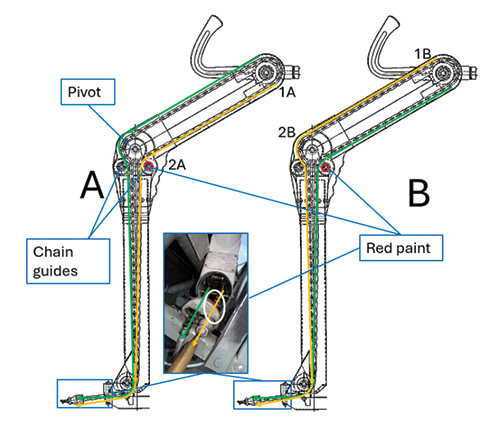
On the occurrence aircraft, the guide block at the base of the control column had a red paint mark.
Above: FAA photo of the Beaver MX procedures, clearly showing the cable routings as found in the manual.
Regulatory Agency Lingo
Because this involves a Canadian regulatory agency, a quick clarification on terminology is helpful. An “AME” in Canada is the equivalent of a licensed A&P mechanic in the United States. An apprentice, as the title implies, is not licensed. That said, “non-licensed” does not mean “not capable.” Canadian maintenance documentation is also somewhat unique. In my experience, aircraft logbooks from Canada are extremely thorough and detailed. They also function as a “journey log,” capturing operational history along with maintenance entries.
Back to the Accident Report
The pilot and the person responsible for maintenance (PRM) discussed the work completed over the winter on three aircraft operated by ETA Aviation & César Camp du Nord Inc., all of which had been stored at Aviation B.L. Inc. Around 1100, the aircraft began its takeoff run to the southwest for a local VFR flight.
As the aircraft accelerated, the pilot attempted to raise the right wing by turning the control wheel to the left. Instead, the left wing began to rise. Reacting to what he was seeing, the pilot turned the wheel fully to the left, which only increased the left wing’s lift. The aircraft then rolled to the right, the right wing struck the water, and the aircraft overturned.
The passenger quickly unbuckled his seatbelt and tried to open his door but could not. He managed to open the window and escape through it, sustaining serious injuries to his right arm in the process. After reaching the surface and catching his breath, he attempted to dive back down to help the pilot. The water was murky, and with his injured arm and heavy clothing, he struggled to swim.
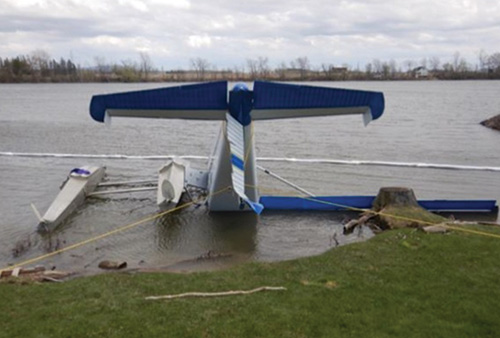
Above: Despite solid procedures in place, a life was lost due to maintenance and pilot error.
Later that day, when the aircraft was recovered and brought to shore, the pilot was found deceased inside, with his seatbelt unbuckled.
Preflight Check
There were two qualified pilots on board, yet neither performed an aileron directional check, even though they had been told that flight control cables had been disconnected. Neither pilot had any type of flotation gear.
What makes this even more striking is that Canadian maintenance operations, based on EASA standards, have a structured system designed to prevent exactly this kind of outcome. It is a process I have emphasized repeatedly to owners and operators: independent verification of critical maintenance tasks. In airline and regulatory language, this is known as an RII, or Required Inspection Item, essentially a required double inspection.
The airline I worked for, like many others, operates under an FAA Part 145 repair station certificate that allows us to work on European-registered/based aircraft. To do that, we had to align our U.S. maintenance documentation with EASA regulations. While their system can be more detailed and paperwork-heavy, most of their standards closely mirror what we do here in the United States. The major difference lies in inspection procedures.
In this case, the Canadian maintenance organization followed that layered inspection approach for flight control cable work. The process worked like this:
- The task, such as disconnecting and reconnecting control cables, can be performed by a non-licensed assistant or a licensed AME.
- A licensed AME conducts all required checks, including verification of directional control, and signs off that the work has been completed correctly and no defects are found.
- A second independent licensed inspector performs another complete review, effectively double-checking the work of the first inspector to confirm everything was done correctly.
The system is designed with redundancy on purpose. Critical flight control work is never supposed to rely on one set of hands or one set of eyes.
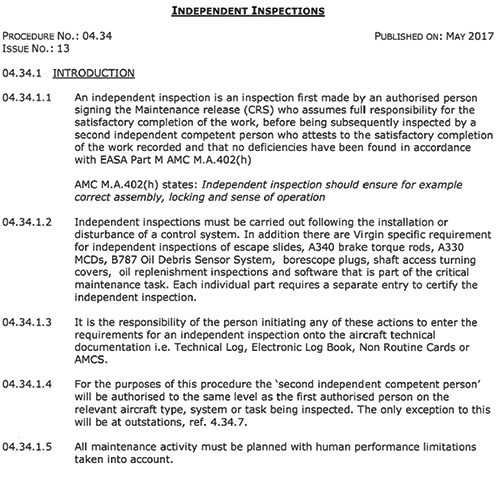
Above: This is a sample independent inspection EASA implementation document.
What Can We Learn?
The first AME did not verify correct control response and the second independent inspector apparently did not physically go out to verify the work, which would have uncovered the problem missed by the first two maintenance individuals. He blindly covered the paperwork with time and dates, perhaps trusting the work of his teammates, and released the aircraft to the pilot.
The takeaways of this accident are so important for readers to understand as well why this type of accident is so distressing for someone with inspection experience. From past articles, I have reinforced the legality that you, the reader and aircraft owner, are responsible for the maintenance and safety of your aircraft. Put yourself in the Beaver cockpit. Would you question maintenance on exactly what was done on your plane or would you go by the documentation on the work order?
In past articles I have mentioned the benefits and pitfalls of using a “second set of eyes.” From a maintenance perspective, this process should always work. It did not in this case due to human factors (the possible distraction of the maintenance staff). The other two failures that led to this accident were: (1) Not following established processes by the second independent inspector and the non-action by two qualified pilots. The only thing left that may have prevented disaster is the process I am urging owners to adopt. Read “A Maintenance Paradigm Shift” in the October 2025 issue of Cessna Owner magazine.
Protect Yourself
When my plane is in the possession of a maintenance facility, I ask for photographs of major and critical events done on my plane. A “photo log”, if you will, to compliment my aircraft records. If I can have 200 pictures of grandkids on my phone, the shop can provide me with at least 20 of all the cable turnbuckles and clevises they safety wired. Act as a third RII inspector by checking to make sure that all things are in working order after maintenance is performed.
“Wearing flotation devices, even in non-commercial operations, can save your life.“
For example, did you have a fuel system set up? Ask the shop to show you that they torqued and used torque putty on all the B-Nuts. Carburetor replaced? Ask the maintenance shop to show you a photo of the throttle and mixture control attach points so you can see the cotter pins. Do these things so that an accident like this doesn’t happen to you.
The Takeaway
The Canadian TSB and the U.S. National Transportation Safety Board (NTSB) have previously investigated improperly connected flight controls, that were not detected during the aircraft maintenance inspection process. The above occurrence is very similar to the investigation of a loss of control and collision with terrain by a Diamond Aircraft Industries GmbH DA 42 NG aircraft, which determined that the rudder had been reversed. In that occurrence, an apprentice performed maintenance on the flight controls without referring to the manufacturer’s procedures and with no direct supervision, and the independent inspection of the work was incomplete.
The Canadian TSB, in the safety messages summaries, included emphasis on the importance of the independent inspections and the effects of distractions. I have always taught mechanics and owners to never interrupt critical processes, like oil filter installations, cylinder installations, and flight control rigging, as examples. In addition, the TSB highlights critical preflight activities and to be more vigilant if any work that was performed was more than just routine service. Wearing flotation devices, even in non-commercial operations, can save your life.
Given the amount of time I spend reading accident reports, just in the United States, I would venture to say we see at least one event a year that mirrors control reversal accidents.
Here is another example. Location: Anchorage, Alaska Accident Number: ANC14FA050 Registration: N3512M Piper PA-12 Event: Flight control system malfunction/fail. Injuries: 1 Fatal. We will discuss this accident in a later article.
AUTHOR BIO
Carl Ziegler, A&P/IA
Carl has close to 50 years of continuous experience working as an aircraft technician and 38 years as an IA. In addition to GA, he has acquired over 38 years of airline experience with Northwest and most recently with Delta, finishing his last 13 years of airline service as an aircraft inspector. He currently flies a 1976 Cessna 172N.