How to Choose Your Plane and Prepare for Insurance
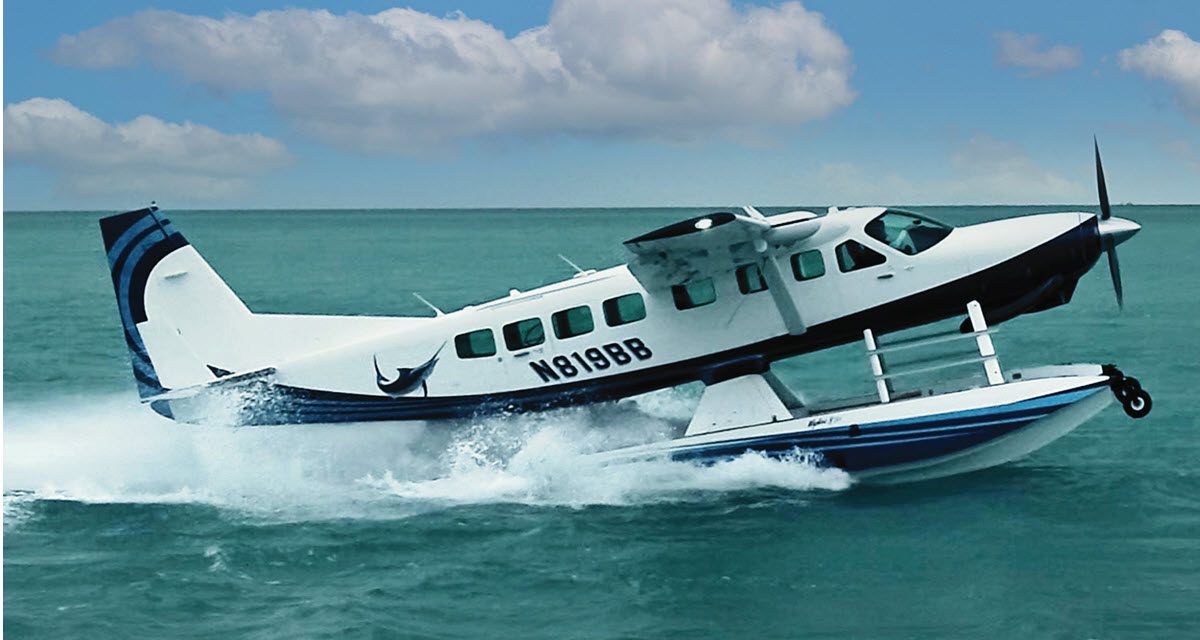
Photo above: Caravan on Wipline 8750 floats, Courtesy of Wipaire
I grew up with boats. We had ski boats, fishing boats, canoes, kayaks, and sailboats. Boating is just a part of my activities, along with flying. I do have to admit, flying is probably a better all-around hobby. While the boat gets parked for the winter, the aircraft can be flown year-round. Depending on who you talk to, boating or airplanes both cost a lot of money. But when you divide the costs by the hours of use, the aircraft might come out a little better than a boat, at least in the upper Midwest.
If you are a boater and a pilot — who wouldn’t like to mix both hobbies? And at this time of year, it seems that not only are people getting their boats ready, but they also start to think about buying or flying a float plane.
My Float Plane Demo Ride
Several years ago, I decided to write a story about learning to float fly — to cure the itch, so to speak. I thought I could fly around the lake to get it out of my system and be back on dry land where the rubber meets the asphalt.
I took advantage of the seaplane fly-in at Lake Parker, outside of the Sun N’ Fun event in Florida. I got a demo ride in a Zodiac 601 that was equipped with a set of amphibian floats. Amphibs are the perfect compromise, allowing the owner to fly from land — with the wheels down, of course — and from water with the wheels up. I could have the best of both worlds.
Float fly-ins? Yes, those are a thing. I should mention that AirVenture in Oshkosh and Sun N’ Fun are both fantastic events that usually offer the float-plane enthusiast the opportunity to see and maybe even fly a float plane. If you are planning to attend any aviation events, check out the float-plane situation. It is one of the few places you will be able to see several different float planes together on one lake. If float planes have your interest, start planning early, contact the float-plane manufacturers, and get on their demo flight list. You don’t want to miss out on your best opportunity to shop the float-plane market.
Back to my float plane experience — I probably shouldn’t have taken the ride. It was about the coolest experience I can remember, that combination of water and airplane. It helped me understand the interest that pilots have with flying off water.
Two Types of Float Planes
There are basically two types. As an insurance agent, the calls I get are typically for the first type, a standard land aircraft with the addition of floats (sometimes called pontoons). Interesting side note: some of the old-style floats and ultralight floats look like pontoons on a pontoon boat. If you think of the way a pontoon was designed, it is a displacement hull. It displaces a certain amount of water. It wasn’t really designed to lift the pontoon up as it moves forward; it plows through the water. So I don’t think they are very practical for an aircraft float.
Even today’s pontoon boat designs are more efficient than the pontoon boats of our past, with lifting strakes and chines that lift the pontoon up to the top of the water, reducing friction and providing more speed. You might notice the newer, nicer pontoon boats are much better at water skiing or pulling a raft. That more modern design is what’s needed in an aircraft float. You need to be able to assist the aircraft in getting off the water and into the air. Modern floats have a lot of things designed into the float to increase the lift and buoyance. Like pontoon boats, “they aren’t your dad’s floats.”
The second float plane is often termed a flying boat or hull seaplane. The hull is the main pontoon, and there are usually wing-tip floats that keep the hull level. Think Lake Buccaneer, or the TV favorite “The plane, the plane!” Grumman Widgeon.
How Big Is Your Float?
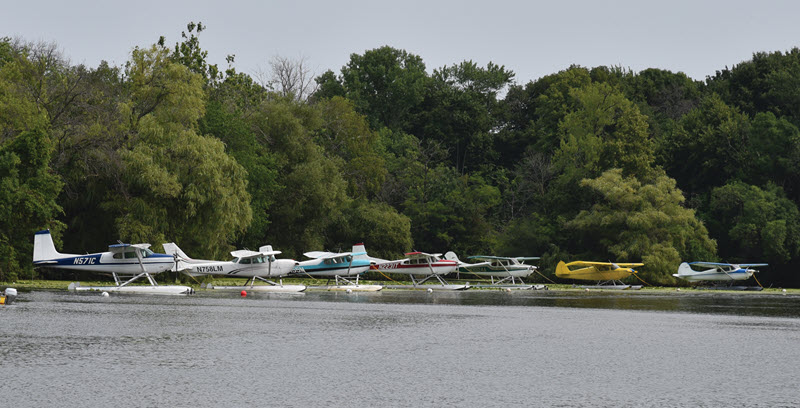
Many people don’t understand how floats are rated. It is by the weight they can support, which is determined by the volume of fresh water they can displace. Simple example: A 2500 float should displace 2,500 pounds of water when pushed just under the surface. It can support 2,500 pounds, so two 2500 floats should displace around 5,000 pounds of weight. But remember that is submerged just under the surface weight, meaning the floats would be underwater, which is not very good for a float plane.
The FAA guidelines try to help with that issue, and they take it one step further and state, “For safety, regulations require that the floats’ buoyancy support 80% more than the aircraft’s weight, or 180% of the aircraft’s weight.” In this example, a plane with two floats at a total of 5,000 pounds should give a maximum weight of the aircraft at around 2,778 pounds (5,000 divided by 1.8). There is an FAA seaplane handbook — download it here.
Two Types of Floats
The regular land plane float plane also comes in a couple types: Amphibious and straight floats. Straight floats are just that — floats only, no wheels, reduced risk. Amphibious floats have retractable wheels that will go up for water use and down for land use. Of course, wheels make the aircraft more useable — no need for the dolly that would get the straight float-equipped plane to the boat ramp. With amphibs, you just taxi out of the hanger, down the boat ramp, and motor away.
But with wheels comes risk. Forget to put them up, and you get an instant submarine. Forget to put them down, and you grind away at the floats. Even the strongest keel doesn’t last long on concrete.
Coast Guard Rules
One thing to think about when you are on the water is that you need to know the Coast Guard boating rules, because you are kind of a power boat. But you also need to know the FAA rules, because you are an airplane that is simply landing and taking off from a water runway. So it’s not just kick the tires and light the fires — there is a lot more to it.
With that in mind, let’s talk insurance. Let me say right up front, float flying is not for everyone. Floats slow the plane down; float planes are not fast cross-country cruisers. The floats bring a lot of drag hanging off the bottom of the plane. That not only cuts into your speed, but also your fuel burn, and it increases the maintenance and risk of corrosion, not to mention that they’re harder to get into. It could be considered good for your agility workout to climb up the floats and steps to the cockpit, or check the fuel tanks. Plus, now you might need a new hangar with a taller door and roof.
Even if it’s your dream, depending on the type of plane, the type of floats and the type of pilot, you may or may not get a quote. And one thing is for certain, it will be more money than a land aircraft of the same make and model.
Flying boats (type two on the previous page) are usually the most difficult to insure and the highest-priced. My opinion why is because the hull is the fuselage. Any minor damage to the flying boat hull (like hitting a submerged log or alligator) and it is a major repair to the structure, whereas if you damage a float, you get a new float, not a completely new fuselage.
The lowest insurance is typically straight floats. No worries about putting wheels up or down. One choice: Land on water.
Because of their versatility, the most popular choice is amphibious floats, and they’re probably the best all-around system. You can keep the plane at an airport, fly to the water, and bring it back to an airport. Just don’t forget you have wheels — and yes, that happens. We have had very experienced pilots who forgot to put the wheels up, and the plane was upside down in seconds. It happens to the best pilots, so it is a risk. The underwriters know that, and they charge accordingly.
Float Plane Insurance Rates
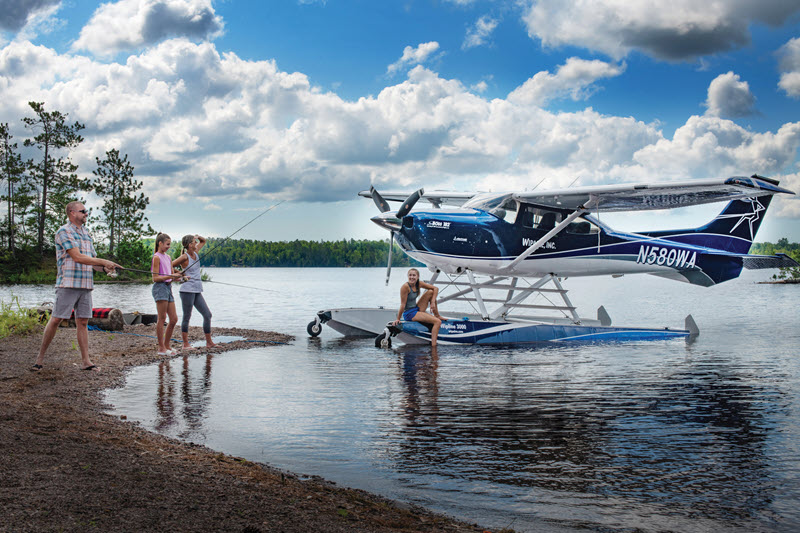
Rates are pretty high on float planes, in part because so is the insured value. You have the cost of the aircraft, whether it’s a Super Cub or Cessna 180, and then you add the cost of floats. Amphib floats can be $30,000 to $50,000. That total package price means higher premiums than a wheel aircraft. Recently we quoted a Cessna 185 on amphibs for a total value of around $300,000. The premium for the experienced seaplane pilot was over $9,000 a year. But don’t let that deter you; we have had quotes for liability only at around $1,000, and other full coverage over $50,000. It all depends on the plane and pilot.
What You Can Do to Prepare for Insurance
Probably the biggest issue is getting the seaplane rating and the required training. The rating is the easy part. Getting the required dual that the underwriters want is difficult. Usually, you will need the rating and about 10 hours minimum of dual in the same make and model seaplane you want to buy. That really means you need to buy the plane and find a qualified instructor to give you the dual, because your chances of finding your make and model plane to rent for those 10-plus hours will more than likely be difficult.
Another thing with insurance — many of the underwriters (and there are only a few that quote float planes) are now offering one quote. It used to be that many a seaplane had the floats removed for the winter and the underwriters would change the coverage to wheels, thereby reducing the premium. That doesn’t happen much anymore. Basically, the underwriters have changed their rating structure to take into account that you are going to remove the floats, so they don’t have to change the policy during the policy period. So when you get the quote, it covers the plane on wheels or floats. That is a better way to go. There are no more worries about making the change or not having the right coverage.
Float Plane Tips
- Choose first: Straight floats, amphibs, or amphibian plane?
- Where will you get the training?
- Can you get the needed dual?
- Can you land on water where you want to fly?
- Where will you base it? Will it fit in your hangar? Floats increase the overall height.
- Do you need Insurance? Hull coverage? Liability only?
- Join the Seaplane Pilots Association (seaplanepilotsassociation.org)