How to Lower Stall Speed and Improve Control at a Higher Angle of Attack
By Chandler White, Micro Aerodynamics, Inc.
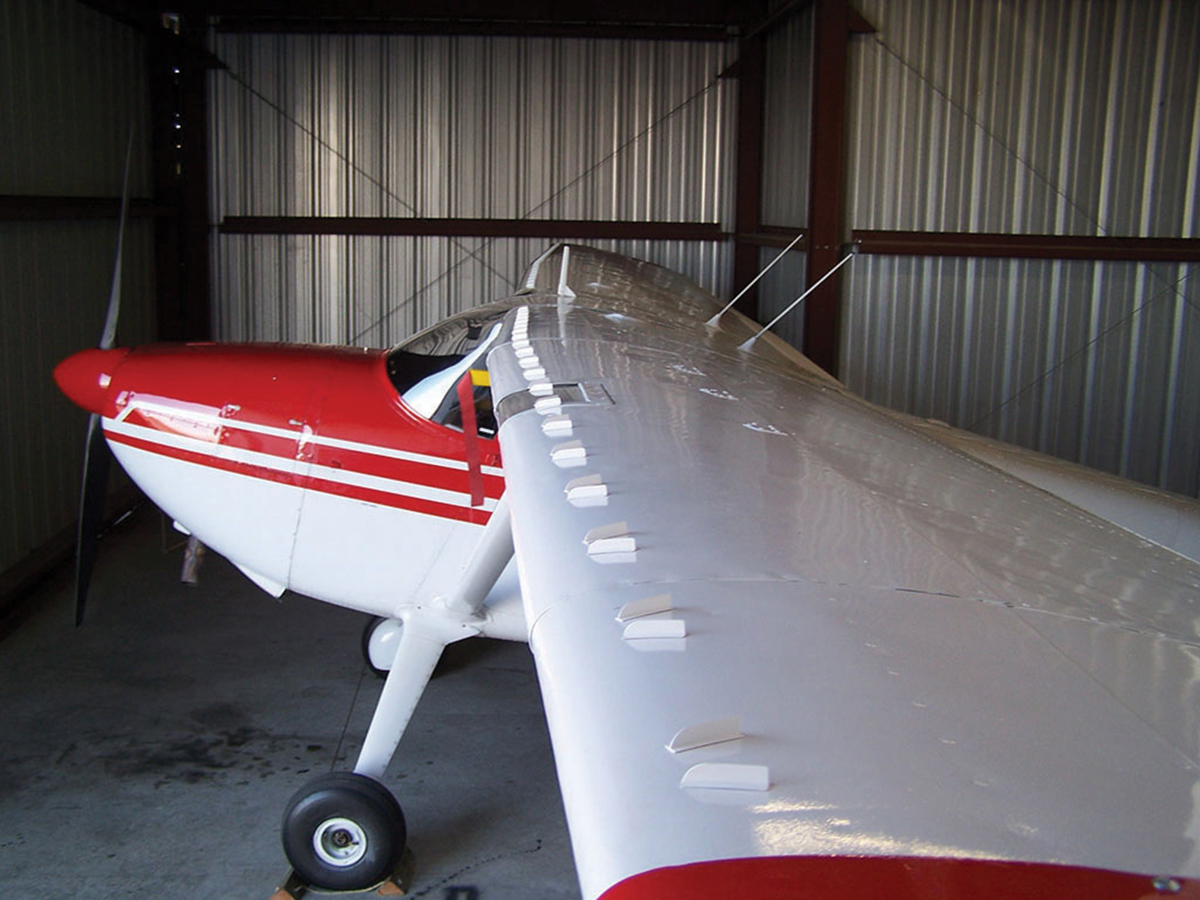
Vortex generators (VG) are counterintuitive little marvels of fluid dynamics. How can something that deliberately disturbs airflow make it behave better?
Explaining VGs to a five-year-old, you might say they help air “stick to the wing.” That’s not a bad summary. But the real story involves several aerodynamic concepts working together.
The Aerodynamic Concepts
Air likes to flow from regions of higher pressure to lower. It naturally flows down a pressure gradient, not up. But air moving fast enough has sufficient momentum to push “uphill” against increasing pressure. That detail matters.
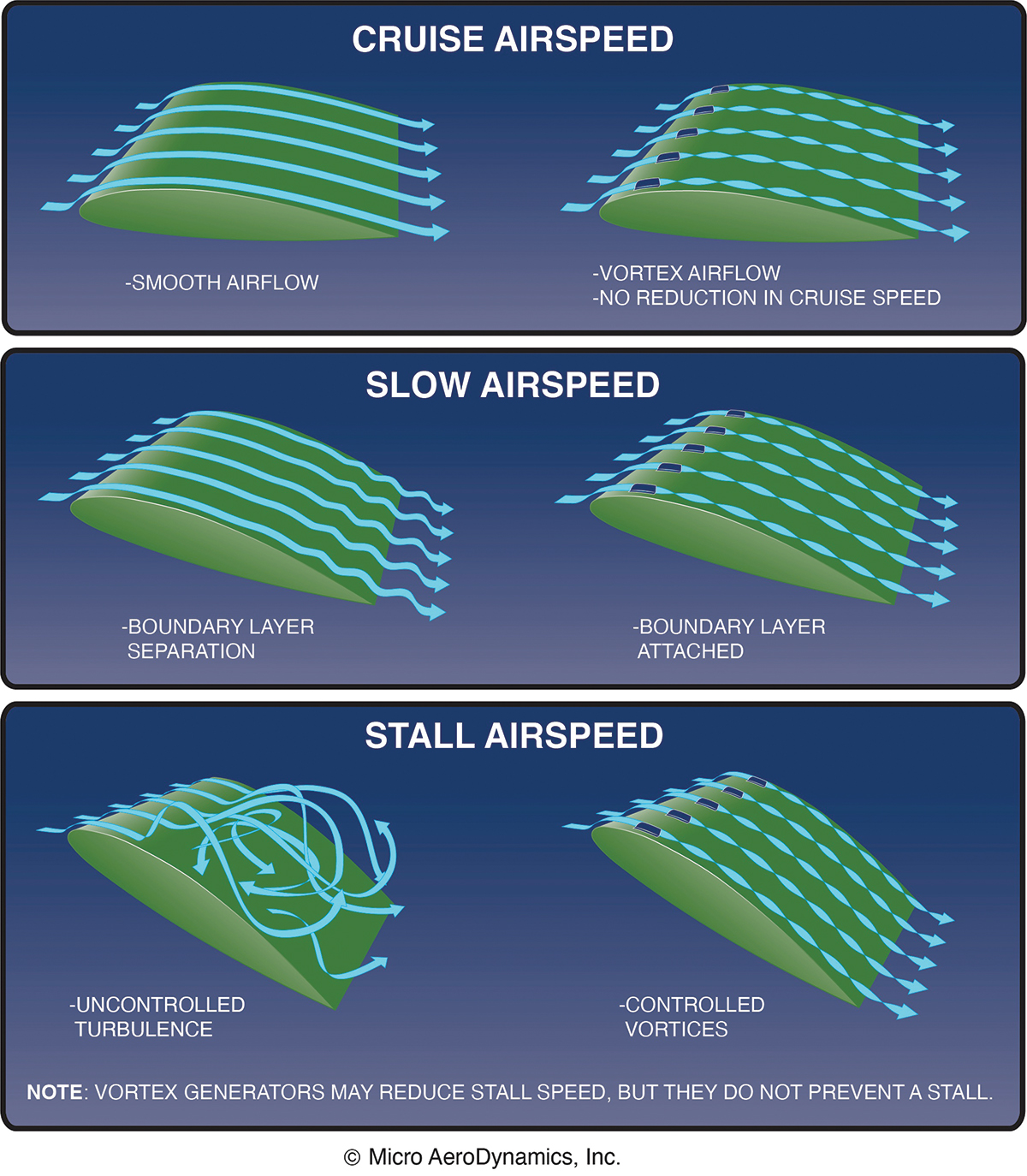
The adverse pressure gradient. Over the top of a wing in flight, pressure is lower than below (thank you, Bernoulli). What’s less commonly discussed is what happens as air travels from the maximum airfoil thickness toward the trailing edge. Pressure begins to increase slightly in that region. This is an adverse pressure gradient. Air flowing aft is now moving into increasing pressure, essentially uphill. At cruise speeds, this is no problem. The air has plenty of momentum to push through that gradient and keep flowing aft. But as airspeed decreases and angle of attack increases, airflow loses energy.
Near stall, air struggles against the adverse pressure gradient. Eventually it loses the fight. Flow starts to reverse direction, and that marks the beginning of a stall.
You can see this in tuft testing. As a wing approaches stall, tufts near the trailing edge start dancing erratically, then point forward. The region of forward-pointing tufts grows until much of the airflow is separated. That’s a fully developed stall.
Flow separation starts at the Boundary Layer. You’ve probably heard the boundary layer described as a layer of “dead air” stuck to the wing. That’s close, but not precise.
Imagine being able to see airflow the way Kelly Johnson (designer of the SR-71) was said to “see air.” Right at the wing surface, air molecules are stationary, they stick to the surface. Just above that, molecules move slowly. Higher still, they move faster. Eventually they reach full freestream velocity.
That transition region, from zero velocity at the surface to full velocity away from it, is the boundary layer. And it thickens as you move aft along the wing.
Importantly, the boundary layer contains the slowest-moving air. That’s the weakest link when the adverse pressure gradient starts working against the flow. Flow separation begins inside the boundary layer.
Energizing the Boundary Layer. This is where vortex generators come in. A VG is mounted near the leading edge, at a small angle to the airflow. It’s mostly inside the boundary layer with just the tip in faster freestream air. Like a tiny wing tip, the VG sheds a swirling vortex. That vortex mixes high-energy freestream air into the low-energy boundary layer.
That added energy resists the adverse pressure gradient. Flow continues rearward instead of reversing. Separation is delayed and stall occurs at a higher angle of attack.
What It Means For You
Aerodynamically, VGs increase the maximum lift coefficient. In practical terms, that usually means lower stall speed and improved control at high angles of attack. That’s why bush pilots appreciate VGs: slower stalls and better aileron authority in the flare.
The same principle applies anywhere airflow must turn more sharply than it “wants”. Elevators, rudders, and engine nacelles all benefit. On light twins, VGs installed on the vertical stabilizer help reduce Vmc, a change that is genuinely lifesaving.
Here’s a simple design rule: If airflow is about to encounter a region where it must turn harder than it wants to, that’s a candidate location for VGs. Put small vortices ahead of big separation problems and let fluid dynamics do the rest!
ABOUT MICRO AERODYNAMICS
Micro AeroDynamics Inc. is a small company located in Anacortes, Washington developing and marketing Vortex Generator kits for light general aviation aircraft. Since 1989 thousands of Micro VG Kits have been sold worldwide. We are extremely proud of our products, which are credited with saving the lives of several people and their aircraft.
Micro AeroDynamics, Inc.
4000 Airport Rd, Suite D
Anacortes, WA 98221
800-677-2370
360-293-8082
microaero.com