I can tell you that at 75 years old … time flies whether you’re having fun or not. It seems to pass faster the older we get! Time plays a role in flying. When we fly commercial, it’s all about what time to get to the airport and finally what time we will arrive at our destination. We express our flying experience in our number of flight hours and even the value of our airplanes is directly affected by total flight hours or hours since overhaul. Flying for fun in VFR conditions is less time sensitive but flying extended cross-country, even VFR, has us watching the clock.
In 1988, I took time between jobs to do something I always wanted to do. I left Hartford in my Cherokee Six and flew solo across the country. I removed the rear seats, filled the back with my tent, ten-speed, and golf clubs, and headed out in June for what turned out to be a six-week adventure. My goal was to play Pebble Beach in Southern California and return to Hartford whenever I got there. My plan was to camp under the wing one night and stay in a motel the next. I flew four-hour legs and with the Six’s four fuel tanks, I was changing tanks every hour. Unlike many Cessnas that allow you to choose both tanks, Pipers, at least early Pipers (mine was a 1969), do not give you this option. Forgetting to do this in a Six and you get a heavy wing in a hurry. To avoid that situation, I ignored conventional wisdom and chose to drain the tip tanks first. Flying VFR, I was constantly watching the clock. In this environment, a panel mounted clock is not a required piece of equipment.
Flying IFR
Once you have decided to enter the world of IFR flying, a reliable, panel mounted clock or even better, a digital chronometer is required equipment.
Under 14 CFR Part 91.206 (d)(6) of the Code of Federal Regulations, a powered civil aircraft with standard U.S. airworthiness certificates under instrument flight rules must have, “A clock displaying hours, minutes, and seconds with a sweep-second pointer or digital presentation.”
Simply stated, if you’re updating your aircraft from VFR to IFR, or even Light IFR, you need a clock. I’ve spent the last twelve years helping clients do just that. When a clock is not present, or the original windup clock is (some are actually still working), I point out the need to upgrade.
Clock Options with IFR in Mind
We have come a long way from the original wind-up clock that came from the factory in legacy aircraft panels. We still see this design available but primarily powered by the aircraft’s electrical system.
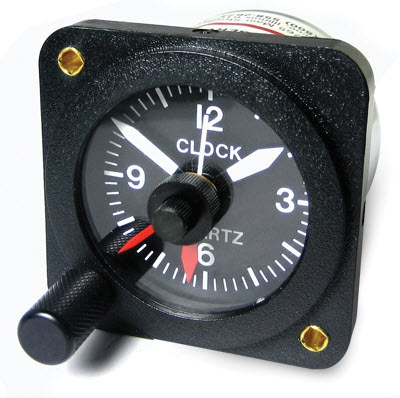
Quartz Electric Clock at $160
I don’t see any wind-up clocks on the market. This is what you find in a basic, electrically driven 2 1/4″ clock today. It tells time but reviews suggest that if you don’t fly frequently, it can run your battery down. Digging more into the product, it looks like the Quartz clock is made by Instrument Services, Inc
Chronometers
The rest of this article can be seen only by paid members who are logged in.Have a website login already? Log in and start reading now.
Never created a website login before? Find your Customer Number (it’s on your mailing label) and register here.
JOIN HERE
Still have questions? Contact us here.