By Carl Ziegler, A&P/IA
It’s a typical day and your spouse (or child) greets you at the door with the statement, “I think something is wrong with my car.”
We have all heard it and we all know what it means. You head out to the vehicle, hop in, and go for a ride. Returning home you inform your family member that you could not find anything wrong with the car. An hour later your phone rings. The vehicle is stranded in a parking lot with a transmission that won’t go into gear.
What Does This Have to Do With Planes
A recent query had an owner asking where to get his landing gear hydraulic power pack overhauled. Several respondents wanted to know why. He indicated that his maintenance shop felt that at the last annual the pump was making “noise” and it would be a good idea to have it overhauled and gone through at the next annual. The owner indicated that he was open to the idea, stating that in the 28-some-odd-years of ownership, no maintenance work had ever been performed on the unit. This sounded reasonable to me, considering the ramifications of an inoperable pump. One of the respondents countered stating that you could open yourself up to more problems with the gear system by being proactive and that under the concept of RCM (reliability centered maintenance), “on condition” operation until failure made more sense. “The worst that could happen,” he countered, “is that you have to pump the gear down.”
If you took your plane that was suffering a mechanical issue to a shop or mechanic, and after they examined it they stated, “Just keep flying it. If it breaks you should be able to handle any consequence.” In essence, the shop is applying a misconstrued concept of reliability centered maintenance that is being espoused as a reason to keep an item in operation as long as you are monitoring it’s “condition.” After all, the gear motor is only making a “little” noise.
Things to Think About It
This will be a simple overview of RCM. What it is, and in particular, what it is not. RCM has its origin in the aviation world and its inventors developed what eventually became the blueprint in the form of a process defined in SAE-JA1011 (Society of Automotive Engineers). If you were to read the text of the SAE-JA1011 the reader would see that while the concept of RCM has merit for Part 91 general aviation operations, the multitude of operating variables we deal with, combined with the lack of consistent data and in-depth analysis, can prevent full implementation of its concepts. This multitude of variables is what prevents or makes it almost impossible to accurately use full RCM capabilities in our low-level aircraft operations.
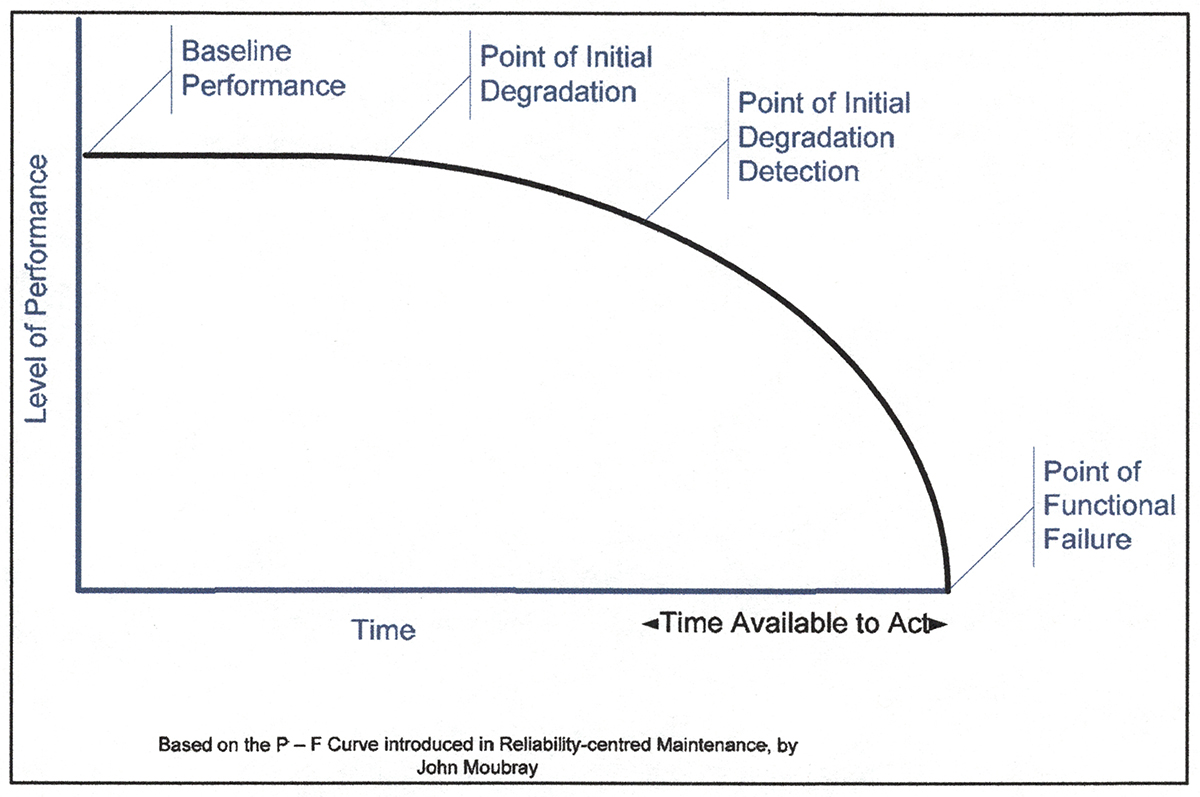
Examine Figure 1. Are you able to apply it to the landing gear hydraulic power pack situation? This chart can be used as a performance/failure analysis tool. Note that our landing gear issue is well along the curve to the point of functional failure. Using this chart, I’d suggest that the shop was trying to get the owner to act while there is still time available to act. Would you concur?
What is Reliability Centered Maintenance?
Simply, RCM is a process to determine what must be done to keep assets doing what their operators want them to do in their current operating context.
RCM is ALL about reliability through data collection, analysis, and application. It involves failure analysis of components at different levels and the effects that these various failures have on operational safety and reliability. Keep in mind that different pieces of equipment will have different failure modes and each of these modes would have to be discovered and assessed.
One application that the concept of RCM is not are operations based solely on the principal of “on condition.” This was not the primary goal of SAE -J11011 developed by the authors for the airline industry.
“On condition” refers to a maintenance strategy where components remain operational as long as they pass regular inspections, rather than having a fixed replacement life.”
The impetus was to streamline preventative maintenance (PM) events to:
- Minimize downtime
- Provide economic benefits
- Gather information on assets to realize the inherent reliability capabilities of equipment and INCREASE safety margins
In order to implement RCM on an asset (an airplane in our case), the authors developed seven questions that must be addressed to each specific asset. As an example, this includes engine, mags, pumps, props, electronics — it’s a long list. Without going into greater detail, here is the list of questions the authors formulated. Each item must be addressed in the following order.
To qualify an asset for RCM under SAE-JA1011, you must:
- Identify Functions – What the system or component is supposed to do
- Identify Functional Failures – How it could fail to fulfill those functions
- Identify Failure Modes – Specific causes of failure
- Identify Failure Effects – What happens when a failure occurs
- Evaluate Consequences – Impact on safety, operations, or costs
- Select Proactive Tasks – Maintenance that can prevent or predict failure
- Determine Default Actions – What to do if no proactive task is feasible
Implementing RCM takes data, LOTS of data.
A Difficult Task
How many aircraft owners have the methods in place to collect, track, and analyze all the potential data that this would entail? Even a massive database of downloaded engine trend data, while helpful in trend monitoring and predictive events, is probably not an RCM program application candidate. Why not? Because of the massive disparity in aircraft and operating parameters in the general aviation fleet from which it is derived.
For example, the way you operate your Cessna 421 is vastly different than the way I fly my Cessna 172. Same model planes are flown differently by different pilots, and each aircraft is uniquely equipped as well as unique in age and condition. Airlines, with massive fleets of one type of airframe (or several), flown and maintained almost exactly the same, can glean copious amounts of data in real time in order to monitor asset condition and reliability. This is why RCM implementation is a function of an engineering or reliability department.
RCM in General Aviation
With the earlier situation of the landing gear hydraulic power pack overhaul, who do we have in our engineering department for Part 91 operations that we can utilize? Manufacturers for one. They set time or hour limits on components, publish service bulletins (SB) and service letter (SL) data. They have engineering departments we sometimes call on for clarification. How about your routine maintenance provider? I have several aircraft I have maintained for almost 20 years, and I monitor them like my own personal aircraft. Familiarity with each gives me an advantage in assessing
operations, wear patterns, and airworthiness. If you have been using the same maintenance group for years, I would expect they would know your plane’s history and peculiarities as well. If they were to recommend certain actions or proactive maintenance, I would expect their advice to be based on a style of RCM procedure, even though they may not knowingly be implementing this concept. The manufacturers are the only ones that may have data on assets, as well as the methods to assess and disseminate recommendations (while controversial, TBO times come to mind).
Coming Full-Circle
Reference my opening paragraph regarding a spouse (or other family member) who drives their car on a regular basis is better suited and perhaps more “in tune” with the idiosyncrasies of their vehicle than I might be, given that I may only drive the car once a year. The same goes for your aircraft. How “in tune” are you with your aircraft? Any idea on how long it takes to be at that level?
The Caution Zone
The RCM “defining scenario,” question seven above, is worthy of note.
7. Determine Default Actions – What to do if no proactive task is feasible?
With reference to the landing gear question, question #7 is worthy of note for all pilots, because I think this is the question that people mistakenly latch on to in order to justify the argument for on-condition operations. When you read the SAE abstract and other descriptions of RCM, you find that scenario seven dictates that if a suitable PROACTIVE task cannot be utilized on an asset, then the reactive approach of run-to-failure may be a logical path. Scenario seven is the last course of implementation, not the first.
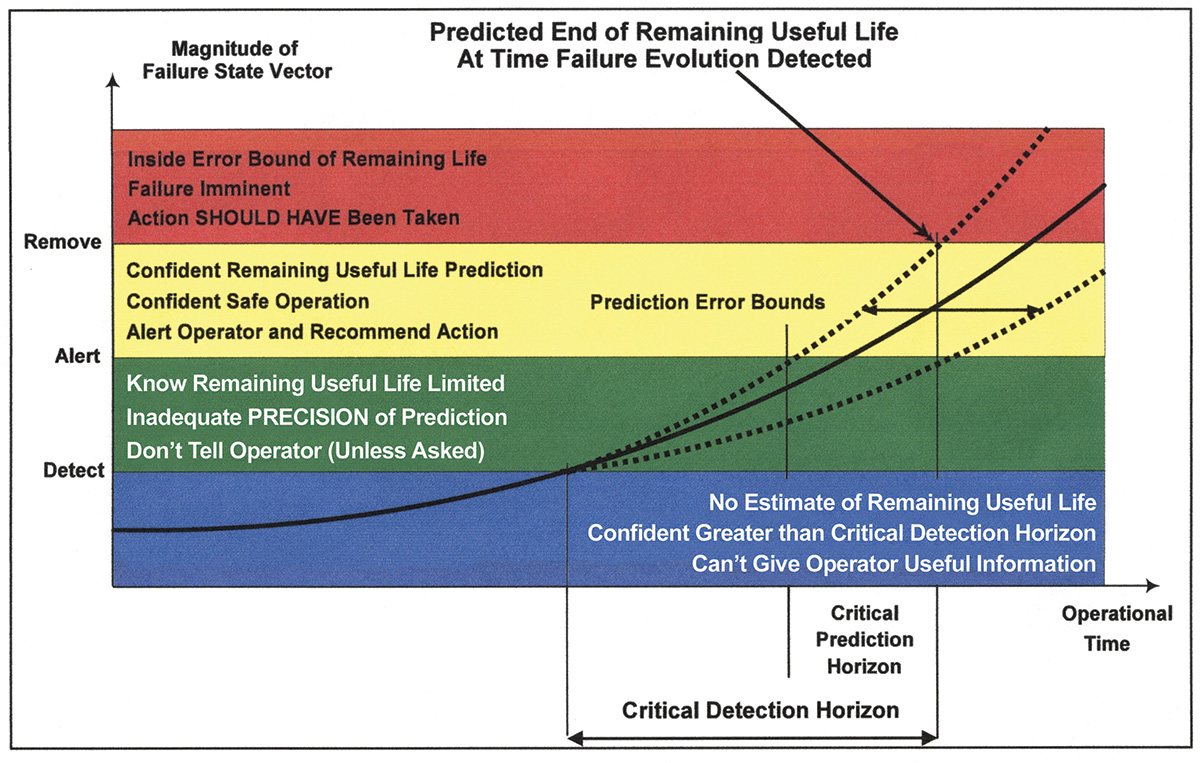
The color chart (Figure 2 above) is a very good, expanded tool to help you visualize the WHEN and IF questions of component degradation analysis. Got a vacuum pump that needs constant “tweaking”? How about that alternator voltage that needs adjustment every year, a noisy gear pump, or “I’m only .5 off” on the localizer when I am centered on the ILS. Plug these into the chart and see how close you are to a “critical horizon.” Make a copy of this chart and keep it with you as an aid in maintenance decision making.
A Look Back
Applying the seven questions of RCM as laid out by the SAE paper (and shown earlier in this article), is it proper to assume that run-to-failure is appropriate in this scenario? Who is taking on the role of the engineering department? Might the maintenance shop have reason to suggest investigation of the pump noise? While I don’t know for certain, perhaps the shop had intimate familiarity with this particular aircraft. Kudos to them and the aircraft owner for being open to the proactive aspect of RCM!
The Takeaway
Despite the ability of modern equipment to provide us with massive amounts of data, there are so many variables that figure into applying RCM in General Aviation. Short of disassembling and measuring wear on bearings, gears, cylinders, etc., we have no idea if a failure event is around the corner. Using the seven defining questions, I DO KNOW that there may be a window when an “event” may be more probable. Teledyne Continental, in one of their “Tips on Engine Care” publications, states that while TBO’s are recommended items, operations past TBO places the onus on the operator to be even more vigilant in monitoring. They correctly point out that conditions such as corrosion and crack defects may not be apparent, no matter how diligent the monitoring may be. The accident reports typically support that position. We don’t routinely disassemble components at an annual inspection.
Aviation safety is not about “pushing limits,” it’s about knowing what and where the limits are. If anyone suggests you run a component to failure, pull out the color chart and see how close you are to an “event horizon.” I will continue to be a plane whisperer, applying the seven criteria and listening to my gut. Stay informed and fly smart.
Note: Figures 1 and 2 are from the NASA RCM guide. The Nowlan and Heap document is basically the SAE-JA1011 document. The NAVAIR document is basically the Navy adaptation of RCM — they took the idea and ran with it. The NASA guide is excellent in its coverage of RCM and conditioned based maintenance.
RCM Resources Here: www.cessnaowner.org/RCM
AUTHOR BIO
Carl Ziegler has close to 50 years of continuous experience working as an aircraft technician and 38 years as an IA. In addition to GA, he has acquired over 38 years of airline experience with Northwest and most recently with Delta, finishing his last 13 years of airline service as an aircraft inspector. He currently flies a 1976 Cessna 172N.