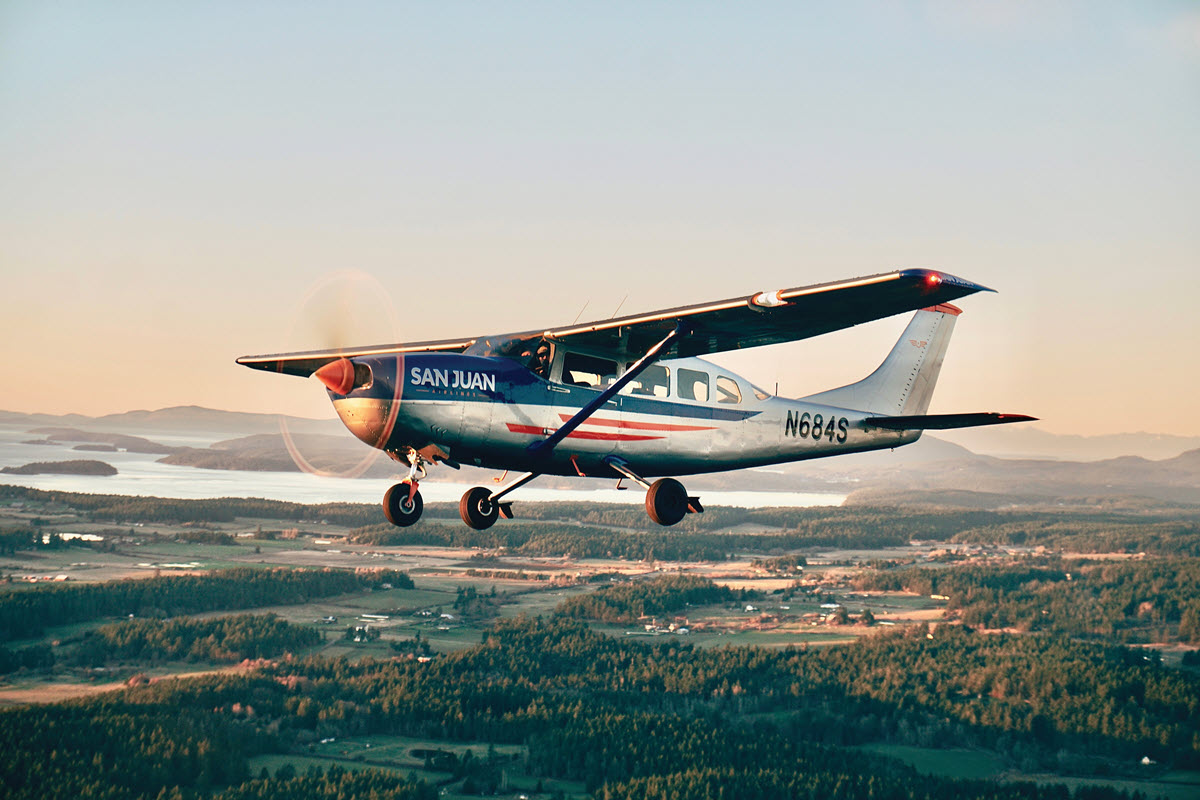
UTILITARIAN
As we climb higher and enter the rocky pass, the Andes Mountains soar high above us. Thirty minutes out of Santiago, Chile, the heavily-loaded Cessna 207 struggles thru 10,000 feet, climb rate down to 200 fpm as I point the nose east toward Argentina. Ahead, the Pan-American Highway snakes up into mountains that knife another two-and-a-half miles into the South American sky.
I’ve passed this way before. I know the lowest crossing point of the Cordillera del Tigre is right at 12,000 feet, designated by a shiny, metal building on a ridge directly above the highway tunnel that bores thru the Andes from Chile to Argentina.
With 100 gallons of ferry fuel in back, two souls up front, emergency gear, provisions, life vests, three portable GPSs, a backup comm and ELT, plus miscellaneous other stuff, the 207 is nearly tapped out at 11,000 feet, but I’m betting there’s lift on the north side of the canyon as there was last year.
We bounce thru the expected high mountain turbulence at Vy, watching the altimeter alternately winding and unwinding as the airplane slowly pogos its way laboriously uphill toward 12,000 feet, stall warning occasionally bleeping in protest.
Finally, after 20 minutes of thermaling uphill with the help of a curious, black South American Condor near the North Face, we’ve chinned ourselves at 12,100 feet. I turn back east toward the narrow notch in the high rocks, wary of any possible downdrafts that might rob us of our hard won height. The final, narrow canyon is essentially one way with no room to turn around. Five hundred yards from the crest and 100 feet above it, I can see the beginnings of a downslope on the opposite side, and with the wind behind us, I know we have it made. We bubble across the tan/brown ridgeline into Argentina, and I have to push forward on the yoke to counter the expected strong updraft.
It’s the last leg of a 14-day trip in Cessna’s largest piston single. We’ve flown from Cleveland, Ohio to Livermore, California to Brownsville, Texas; then south thru Mexico, Costa Rica, Ecuador and Peru bound for the Patagonian Desert in Argentina’s oil district.
A 206 on Steroids
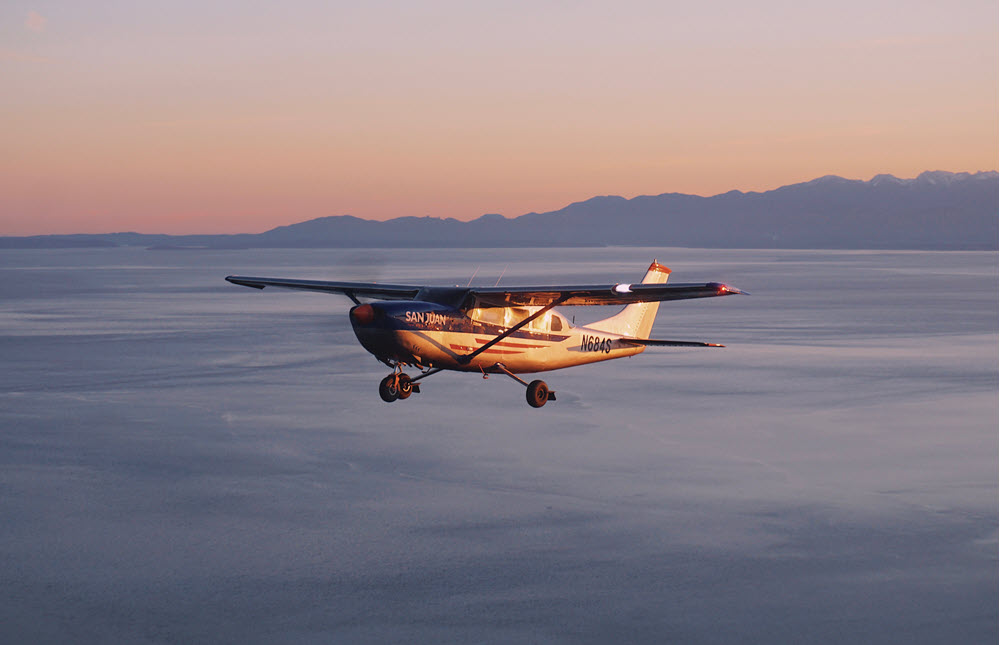
The Cessna 207 Stationair 8 I flew (not to be confused with the turboprop 208 Caravan), is a nicely refurbished 1981 model, complete with a new engine, fresh paint and interior, new avionics and a recent annual inspection, and it has served us well on the long drive south from one America to another.
From the left seat, I could have easily been flying a variety of big Cessna singles, a 182 (the year prior at the same location), a 210 or a 206. Indeed, I’m reminded of a new 206 I flew from Wichita to Capetown, South Africa, twelve years prior to this trip. That trip was 3,000 miles longer but over strictly ocean and jungle, with no giant mountains to surmount.
My current mount is little more than a 206 on steroids, two-and-a-half feet more fuselage with two additional buckets in the extra space, making the airplane technically an eight-seater. That was the motivation for the 207 in the first place — to two-up the popular 206, raise the gross from 3,600 to 3,800 pounds and create an even larger cabin for more people or heavier payloads.
Though it’s definitely the largest machine in its class, the 207 didn’t turn out to be even remotely as popular as its little brother, the 206. In total, Cessna produced almost 8,000 Stationairs in the initial 1964 to 1984 run, but 207s amounted to a small fraction of that.
Price may have been one sales disincentive for the 207. Throughout their mutual production, the 207 was at least 10 percent more expensive than the 206. In the last year of production, 1984, the long cabin model cost an average-equipped $138,000 compared to $123,000 for the 206.
Still, among single-engine piston workhorses, the 207 probably holds the power-lifting record (“probably” because a lightly-equipped Cherokee 260 offers nearly the same load capacity). This airplane, like many of its kind, has seen service in the boondocks before, and to that end, it’s fitted with un-faired, oversized, 8.00 x 6 tires. With a 300 hp, Continental IO-520F on the nose, beefy struts connecting the wings to the fuselage and the longest cabin in the class, the 207 is nothing if not a weightlifter, able to fly with virtually anything you can close the doors on – and there are plenty of doors.
There’s one on each side of the forward cabin for pilot and copilot, two more at right rear for loading people or cargo, and even a forward baggage door to access the CG-saving compartment between cabin and firewall. The 207 offers loading flexibility uncommon in general aviation. The owner of this one modified the aft fuselage with yet another cargo door to accept even longer payloads.
The airplane was designed from the outset for odd-sized cargo. In a word, the 207’s cabin is L-O-N-G. From the forward cabin firewall to the aft bulkhead measures just over 14 feet. At its widest point, the fuselage is only 44.5 inches across, but it’s also 49 inches tall. The CG envelope is wide and accommodating.
Technically, the most significant loading limit is a 200 pound/sq ft weight limitation on the floor structure. The forward baggage compartment can handle as much as 120 pounds.
The Price May be Right
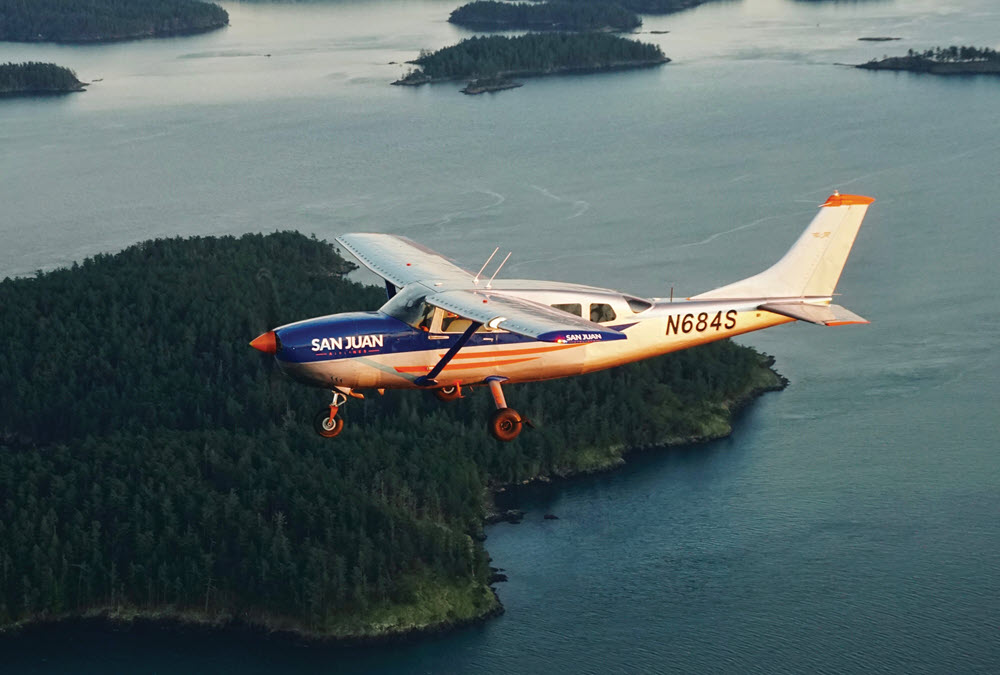
Only the turboprop Caravan can do a better job, though at a premium price and at operating costs several times those for the 207. “My” generic 1981 model 207, confusingly dubbed the Stationair 8 (in honor of its eight seats), lists today at an average-equipped $200,000 to $300,000 depending on hours, condition, and avionics. Don’t forget to add extra for the turbocharged version.
The oldest and cheapest used 1985 Cessna Caravan costs about five times that tab in reasonable condition. These days, a used Caravan from that year lists for as much as $1.3 million.
Compare to the Caravan
What could a Caravan do that a 207 couldn’t? Depends on the mission. Few pilots who buy this kind of airplane care much about how fast they can cruise or climb.
The test is more what you can lift and where you can take it. The ferry airplane boasted a useful load of 1530 pounds, 1092 pounds after pumping aboard full standard fuel, 73 gallons, worse just under four hours plus reserve at high cruise. To carry eight, full-sized folks, our 207 would have had to leave behind all but 20 gallons of fuel, so the mission would indeed need to be short.
A typical, older, 7300-pound Caravan can lift almost 3400 useful pounds, but subtract 2224 pounds of jet fuel, and you’re left with only 1176 paying pounds. Of course, the Caravan is a MUCH larger airplane, with a huge cabin to stuff in whatever will fit (most of the state of Delaware.) Over a ton of jet fuel will keep you flying for six hours plus reserve, but long stage lengths aren’t often a requirement of cargo airplanes, evidence Federal Express use of their 200+ Caravans on average 200 nm hops.
The typical trade-off is fuel for payload. Equalize the fuel supply on both airplanes at four hours plus reserve, and the Caravan winds up with an 1800-pound allowance in the cabin and external cargo pod. (A few years back, I ferried a new Caravan to Nairobi, Kenya with a startling seven, 55-gallon drums of ferry fuel strapped down in back. Total fuel supply was 717 gallons, so I had an easy 14 hours endurance for an absolute range of 2300 nm.)
Unfortunately, at a fuel burn of almost 50 gph and an expensive hot section overhaul price, the airplane’s PT6A turbine powerplant definitely isn’t for the faint of wallet. It’s true the Pratt & Whitney TBO is 3500 hours (compared to almost exactly half that on the Continental), but aside from the inherent reliability of turbines, that may be small compensation for the major nut of purchase and operating costs.
Turbo Option
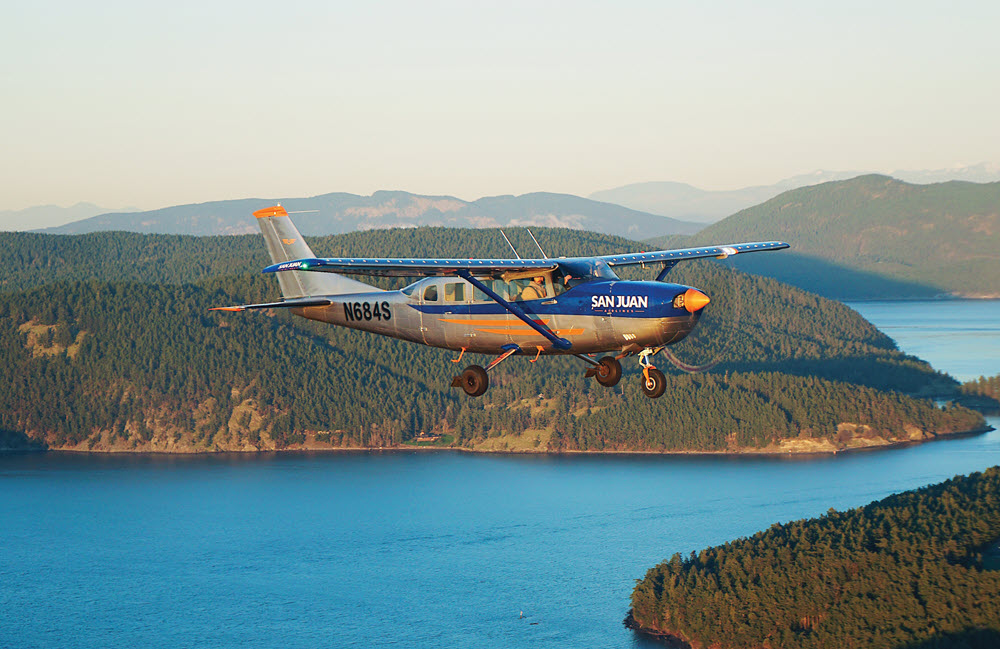
The owner searched the United States for two months before finding this airplane. “At first, we thought we might need a Turbo 207. Our proximity to the Andes made turbocharging look attractive, but our actual mission profiles suggested we’d be transporting loads more south and east, over relatively flat country, so we settled for a normally-aspirated 207.”
Mountain flying or not, the one area where a turbo could be a boon is in lifting heavy loads off even marginally high and/or hot strips. The 207 is a great power lifter, but its weakest suit is probably climb. At sea level and 3800 pounds, the airplane is alleged to levitate a little over 800 fpm, not so bad, but ascent bleeds off rapidly with increasing altitude and temperature. Service ceiling is only 13,300 feet, and even the pilot’s handbook suggests climb is down to 300 fpm at a modest 10,000 feet.
The Turbo 207, fitted with the Continental TSIO-520M and rated for 310 hp to well above 13,000 feet, boasts a max altitude of 26,000 feet, so climb in the low to middle teen altitudes isn’t compromised severely. The blown version works harder, however, and gives away 300 hours to TBO for the privilege of the AiResearch blower. TBO drops to 1400 hours.
Cruising
Speed isn’t either of the big Cessnas’ fortes, but then, it doesn’t need to be. Under ideal conditions, the 207 checks in with 140 knots max cruise, same as a typical 182 or 206. (The Caravan, in contrast, encouraged by twice the horsepower, manages more like 160 knots.)
Apparently, ideal conditions are tough to find. On our trip to Argentina, real world cruise loaded heavy scored 130-135 knots most of the time in no-wind conditions at 5000 to 8000 feet. In a few instances, we were forced to ascend to 10,000 feet to comply with Peruvian/Chilean MEAs, and the big Cessna didn’t like it much.
The 207 had logged more than 65 hours on its roundabout delivery trip from Cleveland to Patagonia. This airplane joined a host of other flying machines that earn their keep working long days in Argentina’s oil business, shuttling people and things between little airports, big airports or no airports at all.
Tough, durable and always willing to find another cheek to turn, the utilitarian 207 provides the engineers and explorers more than their money’s worth.
A RARE HAULER
The Cessna 207 was created in the early 1970s as a practical response to a specific market need rather than as a clean-sheet design. Building on the proven Cessna 206, Cessna engineers stretched the fuselage by nearly two feet to create a six-to-eight-seat, single-engine utility aircraft with greater passenger and cargo capacity. The goal was to offer operators — especially air taxis, bush pilots, and remote service providers — a low-cost alternative to light twins, with simpler maintenance and lower operating costs.
Cessna made the 207 to fill a niche between high-performance piston singles and expensive twin-engine aircraft. It was particularly attractive for short-haul work in Alaska, Canada, and other rugged regions where payload and simplicity mattered more than speed.
Despite its practicality, relatively few Cessna 207s were produced (fewer than 800). The aircraft suffered from limited performance margins when fully loaded, and by the late 1970s and early 1980s, buyers increasingly favored either more powerful singles or turbine aircraft like the emerging Cessna Caravan. Economic downturns and rising fuel costs also dampened demand.
What makes the Cessna 207 special is its unique stretched-single configuration—essentially a “mini-bus of the sky.” It remains valued today for its exceptional cabin space, versatility, and role as an important stepping stone toward Cessna’s later utility aircraft designs.
can be seen only by paid members who are logged in.
Have a website login already? Log in and start reading now.
Never created a website login before? Find your Customer Number (it’s on your mailing label) and register here.
JOIN HERE
Still have questions? Contact us here.