Jack was almost as much of a cliché as the worn, brown leather flight jacket he wore — a fighter pilot grown old, if such a thing is possible. Despite his sometimes quietly cynical disposition, though, we knew he’d long since forgotten more about flying than most of us would ever learn.
Pushing 70 now, the eyes were going, the hands were no longer steady, and the mind was sometimes a little foggy, but he’d been there and done it all. A career Air Force pilot, Jack had flown P- 38s, P-51s, and P-47s at places such as Ploesti, Normandy, and Berlin.
“Trick on the 140 was to leave the power on, pull ’er up to about 30 degrees of pitch, kick the left rudder to the floor at the break, and pull the yoke all the way back,” Jack explained. “She’d roll right over onto her back and enter the spin smooth and clean as you please.
“You got her out by just chopping throttle,
easing the yoke forward, and reversing the rudder. Don’t you boys go trying any of that stuff, though. It’s legal, but you’d probably just screw it up, break the airplane and hurt yourself.”
The ink was barely dry on my private license in 1966, but the rental Cessna 140 parked in front of Mutual Air Service in Hawthorne, California, seemed a perfect invitation to conventional gear. The little Cessna rented for $4.80 an hour dry, and with Jack as my instructor for another $3 an hour (plus fuel), I went on to check out in the 140, log a dozen hours, and discover the joys and pitfalls of taildraggers.
And yes, we did spin it.
Fast forward to a new millennium. Begin comparing classic airplanes, and you can quickly become ensnared in a debate on the relative merits of a variety of machines. It seems there are few givens and about a hundred opinions on classic aircraft.
One of the consistent positive reviews always goes to the Cessna 140. Like so many Cessnas that followed it, the diminutive 140 is almost universally regarded as one of the best airplanes of its type and vintage. The 140 wins rave reviews not because it does any one thing better than any other model, but because it does everything well. In short, it’s among the best at being average or better.
Cessna 120s and 140s were that company’s answer to the imaginary post-war aviation boom that never was. The 120, intended as a bare-bones trainer, was essentially a budget version of the 140 with no flaps, rear side windows, or electrical system in the initial iteration. The ragwing 140 and the later all-metal version, the 140A, were built from 1946 thru 1950. Collectively, there were just under 7,700 Cessna 120s and 140s built, about 2,000 of which are still flying.
Why Buy A 140
So why would you be tempted to buy an antique 85 hp taildragger when, for about the same money, you could probably purchase a 100 hp nosewheel-steered Cessna 150 — at the time, the second most popular trainer in the world (right behind the military North American AT6/SNJ)?
Fun might be a good reason. Fun was the motivation for many of the minimum airplanes of the late ’40s, and the Cessna 140’s fun quotient was/is unquestionably high. I learned to fly in a Piper Colt, about as bland a trainer as there was at the time, and my first flight in a Cessna 140 was like a breath of fresh air.
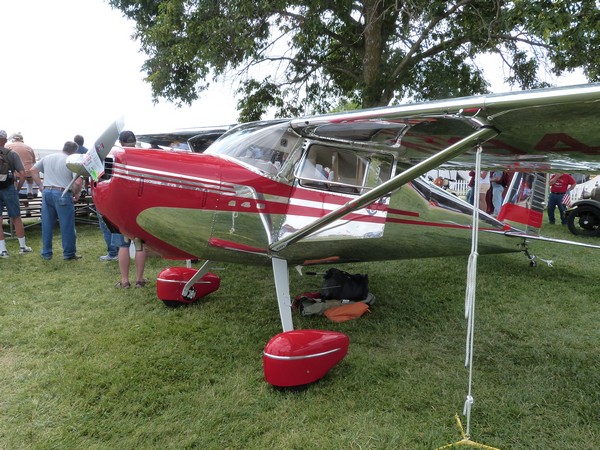
Len Rudrud, formerly of Screaming Eagle Aviation in Santa Paula, California, chose his Cessna 140 simply because, like Everest, it was there. Rudrud is a retired American Airlines captain who knows a thing or three about aviation and also owns a 58TC Baron as hangarmate to his 140. Rudrud bought the little Cessna in the early ’90s and, since then, he’s cleaned and polished, waxed and faired, upgraded and improved. “The 140 was already a jewel when I bought it,” Rudrud admitted. “I just made it better.”
Rudrud added, “I’ve been flying complex airplanes most of my life — three- and four-engine jets and turboprops, and multi-engine pistons with turbochargers, pressurization, and constant-speed props. The nicest thing about the 140 is that it doesn’t have any of that stuff. It’s a simple airplane for a simple mind, almost like flying a piece of Kleenex.”
A Cherry Example
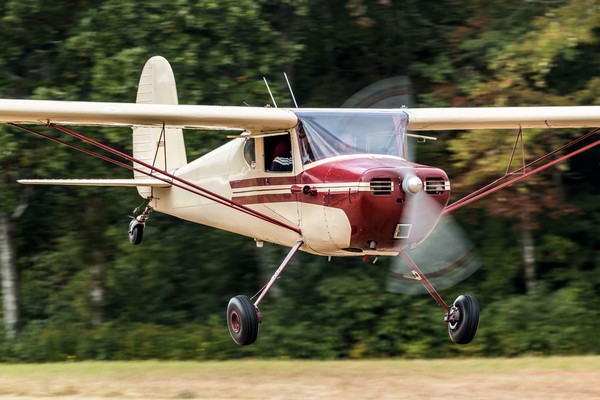
No Kleenex ever looked this attractive. We like to test the most attractive examples of a given model we can find, and Rudrud’s gem certainly qualifies as a best-of-type. Trusting soul that he is, Rudrud graciously handed me the keys to his meticulously restored burgundy 1947 model, so I could renew acquaintance with an old friend.
Like Rudrud said, pure airplane; no frills, no ups, no extras. Just double-strutted wings, two doors, fixed gear, fixed prop, mannual flaps, a bullet-proof C85-17 Continental engine out front, and a yoke, throttle, and rudders following behind to control the whole package. As Rudrud bragged, what could be simpler?
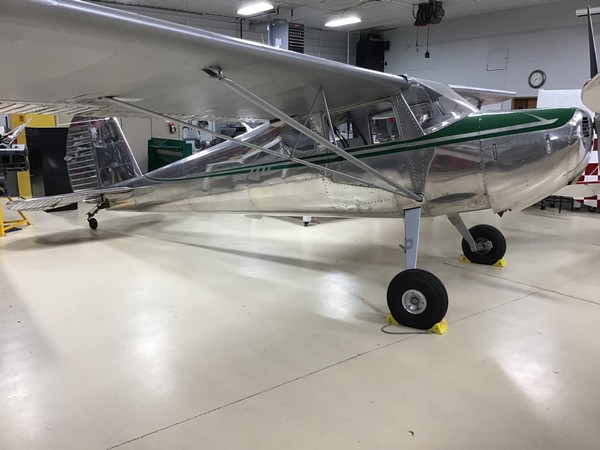
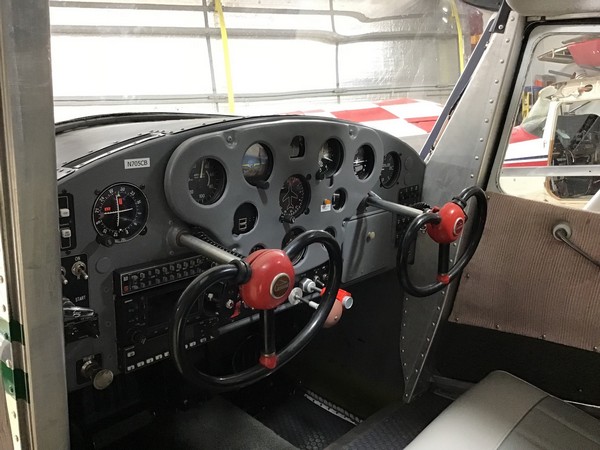
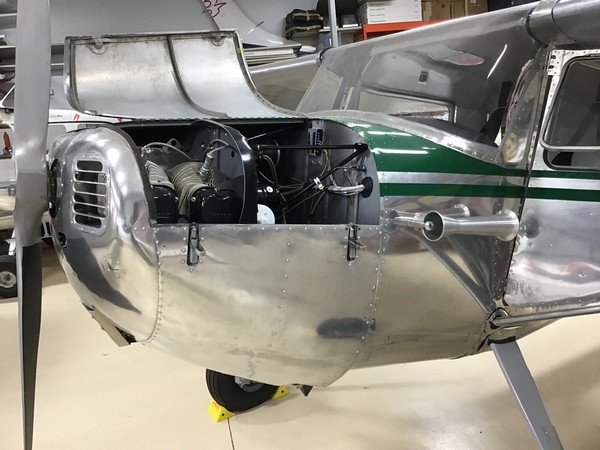
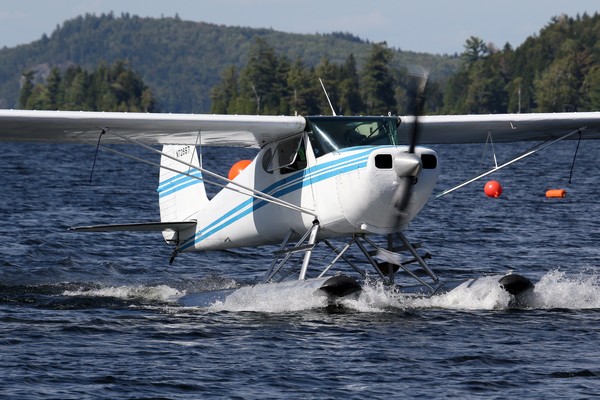
Lyndell Enns sent us these pictures of his newly restored 1946 Cessna 140. This plane has spent most of its life near Alberta. Enns said his parents, who recently celebrated their 60th wedding anniversary, used the plane for everything from groceries to farm work to air ambulance. Enns said he’ll be training his son on IFR flight with this plane, just like his own father did.
Not for the Longitudinally Challenged
The rest of this article can be seen only by paid members who are logged in.Have a website login already? Log in and start reading now.
Never created a website login before? Find your Customer Number (it’s on your mailing label) and register here.
JOIN HERE
Still have questions? Contact us here.
Climb into the small seats through the narrow door, and you can’t help but notice that this would be an extremely cozy airplane for even two modest-sized people, much less today’s more longitudinally challenged variety. The cabin is only about 39 inches across at the elbows and slightly less tall. Rudrud’s bird weighed in at 1,005 pounds against a 1,450 pound gross weight. Payload with a full 25 gallons in the tanks was 295 pounds. That would preclude carrying two typical men with full fuel, though it would probably work OK for a standard couple plus toothbrushes.
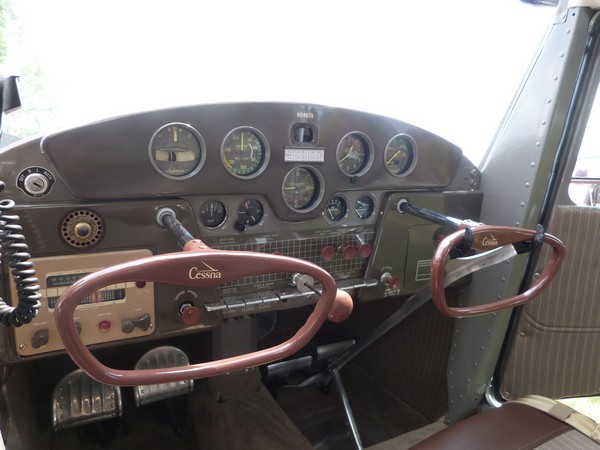
The test airplane was appropriately equipped for operation in and around the Los Angeles Basin, and that meant a 720/200 navcom and transponder/encoder. Additionally, Rudrud had installed an intercom and a pair of ANR David Clarks to help combat the high noise level. This 140 was probably no noisier than most other examples of the same model (it may actually have been quieter because of the high-end upholstery job), but even so, noise level on most older birds was little short of horrible. The decibel count came in at 99, typical of the vintage.
Since the 140 was designed on the KISS philosophy (Keep It Simple, Stupid), there are a minimum of controls to worry about, a good thing, as it turns out, since the panel isn’t large enough to accommodate a major avionics stack. In view of the airplane’s overall simplicity, its state-of-the-art landing light was something of a surprise — an electrically-powered, retractable design that folded flat against the bottom of the left wing when not in use.
Simplicity Was Key
Engine start couldn’t be more straightforward, and taxi is conventional for a taildragger. Rudder pedals are spring-connected to the tailwheel, and accordingly, directional control on the ground is reasonable if not exactly positive. One bit of advice in no-wind conditions: keep the yoke full aft to maximize pressure on the tailwheel and improve steering authority. The cowling slopes slightly downhill from the pilot, and the normal, three-point attitude isn’t too steep, so there’s little need for S-turning to see what you’re about to hit.
Push the power up for takeoff, and not a lot happens. The engine makes more noise, but acceleration is hardly noticeable. Fortunately, stall speed is a leisurely 40 knots, so you need not accelerate much in order to fly. One tip some Cessna 140 drivers use to get off short strips is to lever in 25 degrees of flaps as the airspeed passes about 30 knots. This will help launch you into the air, but you’ll need to bleed off the flaps in order to climb most efficiently.
Slowly But Safely
Nothing happens very fast in a 140, especially not climb. I saw about 500 fpm flying alone from near sea level on a warm day with full fuel and 190 pounds of me aboard. The book suggests a 640 fpm climb in SL/gross/standard conditions at 70 knots. Up at 8,000 feet, climb drops to 340 fpm, it says here.
Though the Cessna 140 came equipped with a mixture control, many pilots barely used it. Total control travel on the knob was only about an inch, making fine tuning difficult. Normal cruise heights are below 5,000 feet, and leaning the mixture has little effect at such low altitude. When the airplane was new, fuel was probably about $.40 a gallon, so the minuscule 5 gph was hardly a consideration in operating costs. At a max cruise 2,400 rpm, the two 12.5-gallon wing tanks provide about four hours endurance plus reserve.
A Mid-Range Machine
At the 140’s characteristic 90-knot cruise speed, you could plan for 350 nm legs. Lower power settings reduce fuel burn slightly, but the loss of airspeed is almost directly proportional, so there’s little real benefit. Typical of most normally-aspirated singles, optimum altitude (where 75 percent is all there is) works out to about 7,000 feet, though the manual lists service ceiling as 15,500 feet. It’s hard to imagine a reason to climb that high in this low-and-slow cruiser.
By any measure, the 140 is a delightful airplane in the sky, possessed of a quick roll rate (for a Cessna), a responsive elevator and even a reasonably effective rudder. I wasn’t inclined to spin Rudrud’s bird during my flights, but the regs suggested I could have. The 140 was certified under the old CAR part 4A, and stress limits were set at +4.57/-2.25 Gs, significantly above Normal category certification under FAR 23.
Despite the Cessna’s pristine condition, time takes an often inexorable toll on airframes, and I’d be reluctant to subject any 1947 airframe to high G loads.
Gentle But Comfortable
Still, it was a joy to roll the 140 left and right to 60 degrees of bank. The aircraft loves to maneuver and makes its pilot feel right at home, perhaps more so than the later 150. There’s no question Cessna made substantive improvements on the 150’s airframe and power plant, but control response wasn’t nearly as good on the newer model.
Dirty stall speed is a low 40 knots, so you can feel right at home flying final at 55 or even 50 knots. Unlike most other Cessnas, the 140’s flaps seem to have little effect on glide path, but that doesn’t really matter, since you can plant the little Cessna and stop in 500 feet or less.
| Item | Value |
|---|---|
| SPECIFICATIONS | |
| Used Price | $16,000 & up |
| Engine make/model | Cont C85-12 |
| Horsepower @ altitude | 85 @ SL |
| Horsepower on takeoff | 85 |
| TBO – hours | 1,800 |
| Fuel type | 80/100 |
| Propellor | FP |
| Landing gear type | Conv/Fxd |
| Gross weight (lbs) | 1,450 |
| Std empty weight (lbs) | 860 |
| Useful load – std (lbs) | 590 |
| Usable fuel – std (gal/lbs) | 25/150 |
| Payload – full std fuel (lbs) | 440 |
| Wingspan | 32’ 10” |
| Overall length | 21’ 6” |
| Height | 6’ 3” |
| Wing area (sq ft) | 159.3 |
| Wing loading (lbs/sq ft) | 9.1 |
| Power loading (lbs/hp) | 17.1 |
| Wheel size | 6.00 x 6 |
| Seating capacity | 2 |
| Cabin doors | 2 |
| Cabin width (in) | 39 |
| Cabin height (in) | 38 |
| PERFORMANCE | |
| Cruise speed (kts) | 75%: 90 / 55%: 77 |
| Fuel Consumption (gph) | 75%: 5.0 / 55%: 3.8 |
| Best rate of climb, SL (fpm) | 640 |
| Maximum Operating Altitude (ft) | 15,500 |
| Stall – Vso (kts) | 40 |
| TO ground roll (ft) | 750 |
| TO over 50 ft | 1,300 |
| Ldg ground roll (ft) | 460 |
| Ldg over 50 ft (ft) | 990 |